

GYO-IL Awards Funding to 16 Community Colleges in Illinois as part of their Diverse Male Teacher Initiative
January 21st, 2026
By Ines Bellina
Grow Your Own-Illinois awarded up to $50,000 in funding to 16 community colleges across Illinois for efforts that support men interested in the teaching profession. Managed by the organization’s Diverse Male Teacher Initiative (DMTI), “Investing in Illinois Community College Teacher Pathways for Community-Connected Males” is a one-time award that will help community colleges implement initiatives in three focus areas: outreach and recruitment, transfer and articulation, and wraparound services.
Since its inception, DMTI has prioritized funding at the community-college level to assist men interested in teaching. This program is modeled on GYO-IL’s teacher grant program, covering the prerequisite courses aspiring teachers need to enter teacher licensure programs, as well as books and fees. Candidates receive one-on-one advising, tutoring, and living stipends. In return, they commit to one-on-one meetings with a coordinator and monthly meetings with their peers, which provides other benefits like professional development, mentorship and networking. DMTI is funded through a separate state budget allocation and does not require a teaching commitment like the larger teacher grant GYO-IL operates.
“We’re looking for individuals who return to their communities, who understand something about their area, which helps them understand something about their students.”
To identify institutions best positioned to advance the work, GYO-IL issued a statewide request for proposals (RFPs), which derived the initial pool of community college evaluated for funding. The RFP represents the first time DMTI has sought to expand its work at the institutional level. GYO-IL invited all 48 public community colleges in the state to submit project ideas that centered community-connected males, which the request for proposals defined as “those who are committed to engaging, uplifting, and leading their communities.” As Deborah Hutti, the Community College Liaison at GYO-IL, explained, “We're looking for individuals who return to their communities, who understand something about their area, which helps them understand something about their students.”
Community colleges applied by submitting a detailed overview of the proposed project that listed its goals, project leader and staff, a timeline of activities and completion, and a budget, as well as its intended impact, effectiveness, and longevity. Despite the tight deadline—community colleges only had 10 days to submit—, GYO-IL received a higher number of applications than expected. “[The colleges] had plans waiting in the wings,” said Dr. Hutti, a former community college administrator. “It looked like they were thinking, “I wish I could do this if we only had some funds.”
Each proposal was evaluated for its potential alignment with DMTI’s goals, the impact it would have on male students, the feasibility of its implementation, the reasonableness of costs, and the sustainability of the project beyond the grant period.
“There needed to be strong alignment, and an intentional and articulated focus on how the work that community colleges were going to do advanced that focus on community-connected males pursuing the teaching profession,” said Kenny Smith, DMTI Program Director. “We wanted to be thoughtful about the kind of impact they could have. For some schools, if you can get one or two men, that's a real impact.”
The new funding program is part of GYO-IL’s multipronged mission to make teaching a viable and desirable career for underrepresented demographics. According to the National Center for Education Statistics, only 23% of K-12 public school teachers are men, with 1.3% of the nation’s teachers identifying as Black men and 2% of male teachers identifying as Hispanic or Latino. Meanwhile, the public school student population is increasingly diverse—less than half of the students (46%) identify as non-Hispanic White. The country is also experiencing a persistent teacher shortage, especially in the areas of special education, elementary education, language arts, and career and technical education. Illinois is no exception to this troubling situation, which disproportionately affects students of color and from lower-income backgrounds.
“When you think about the lack of representation in classrooms and how necessary it is for students to see someone who looks like them,” said Jerry Hinds, the DMTI Candidate coordinator. “It just plays a huge role on the success of our students, and the students are the future.”
With the monetary support from GYO-IL, the selected community colleges can develop projects that help bridge that gap. One of the recipients plans to develop several new education courses within the next six months. Another wants to use the funds to visit 30 high schools in different districts as part of their outreach efforts. Other accepted proposals described co-advising programs, emergency micro-grants, professional learning workshops, and collaborative transfer planning sessions with four-year partners. Some institutions are hoping to collect input from male students to inform program design.
“Research tells us pretty clearly that having educators of color benefits all learners, not just students of color,” said Smith. “In trying to focus on diversifying the teaching profession, we're really investing in creating better outcomes for young people.”
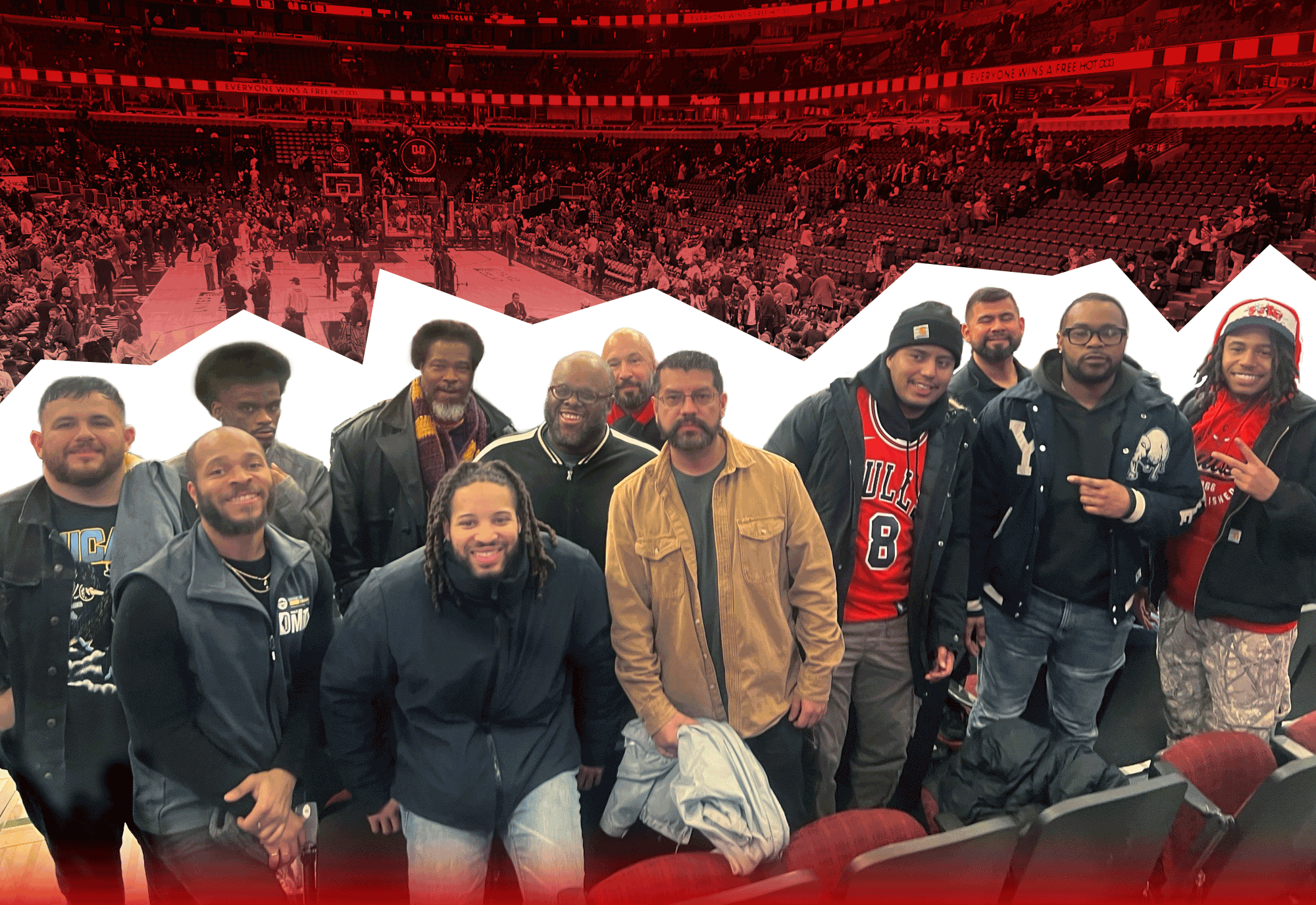
The request for proposals was DMTI’s latest accomplishment in a year of remarkable growth. Early in 2025, the program received state funding which allowed it to ramp up recruitment. DMTI closed the year with 44 students currently in its cohort. This year’s candidates also benefitted from several exciting networking opportunities throughout the year. In November, they traveled to Philadelphia to attend the Black Men in Education Conference (BMEC) where they engaged in professional development focused on identity, belonging, and leadership in education.
GYO-IL awarded funding to the following 16 institutions:
Elgin Community College
Harry S. Truman College
Oakton College
Richard J. Daley College
Southwestern Illinois College